
What's next - getting started with the British Army

If you’re new to 1918 and don’t know where to begin - our Starter Set * is the perfect place to get going.
This set includes two half-platoons: one British and one German. It’s enough to learn the rules and find out what the game is about - but there was a lot more to the Great War than a few infantry tussling in a field!
The British Army began the First World War as the smallest of the Great Powers, though it was most professionally trained. The highly experienced soldiers of the British Expeditionary Force proved their worth in 1914, but long years of fighting had seen those numbers dwindle - reinforced by Lord Kitchener’s volunteer and conscript New Army.
In the 1918 miniatures game, the British Army will likely be the smallest force fielded on the battlefield, but its units are highly experienced, with a strong Veterancy of 3+. You can expect small but tough units, but they struggle with taking pins - machine-gun fire would send even the bravest veterans scrambling for cover, so relying on your Senior Leaders is key.
The Platoon

The core of any force in 1918 is an Infantry Platoon. The Starter set contains three units, a Lewis gun section and a rifle section, commanded by a Lieutenant and his trusty Batman (not that one!). These are your core units, with the Lewis gun available to put down an effective base of fire while your riflemen advance to lob bombs and engage the enemy.

To reinforce them, you’ll need two further sections. A second rifle section gives you that flexibility on the battlefield, while the rifle grenade section gives you some indirect fire support to deal with troops in trenches or shell holes - or even screen your advance with smoke.


Doctrines
In 1918, the Doctrines are a mechanic that allows you to tailor your Force, representing the tactical innovations used by the various nations during the First World War. For the British, this gives you a number of options for each one on how to expand after you’ve played a few games with your Starter set.
Grand Offensive
This doctrine focuses on the large, sweeping engagements that by the end of the war, had become complex, combined-arms operations. Within the British Army, this involves the tanks they pioneered. Once you’ve rounded off your platoon, you cannot go wrong with a 3” Stokes Mortar. This is able to provide long-range firepower to keep enemy troops in cover pinned, but can also provide illumination if you’ve chosen to attack at night.
You’re able to pick up some armour at the Battalion level with this doctrine, so a Mark IV female tank, if you want to keep the enemy infantry pinned, or a male tank if you fear enemy tanks or fortifications. Our kit contains both options and these can be magnetised, so perfect for swapping them out.
Tactical Defense
The British Army was the focal point of the German Spring Offensive, and they held the line despite the overwhelming firepower and rapid advances of the elite Stormtroopers. In the Tactical Defense doctrine, the British Army excelled at holding fast.
In this doctrine, support your platoon with the mighty Vickers heavy machine gun - perhaps one of the most iconic weapons in history. This mighty weapon can be put on overwatch with the Stand To order - able to cover vast swathes of ground and firing shot after shot as enemy troops advance. You can even mount it in a Pillbox - so you can be confident your flank is secure.
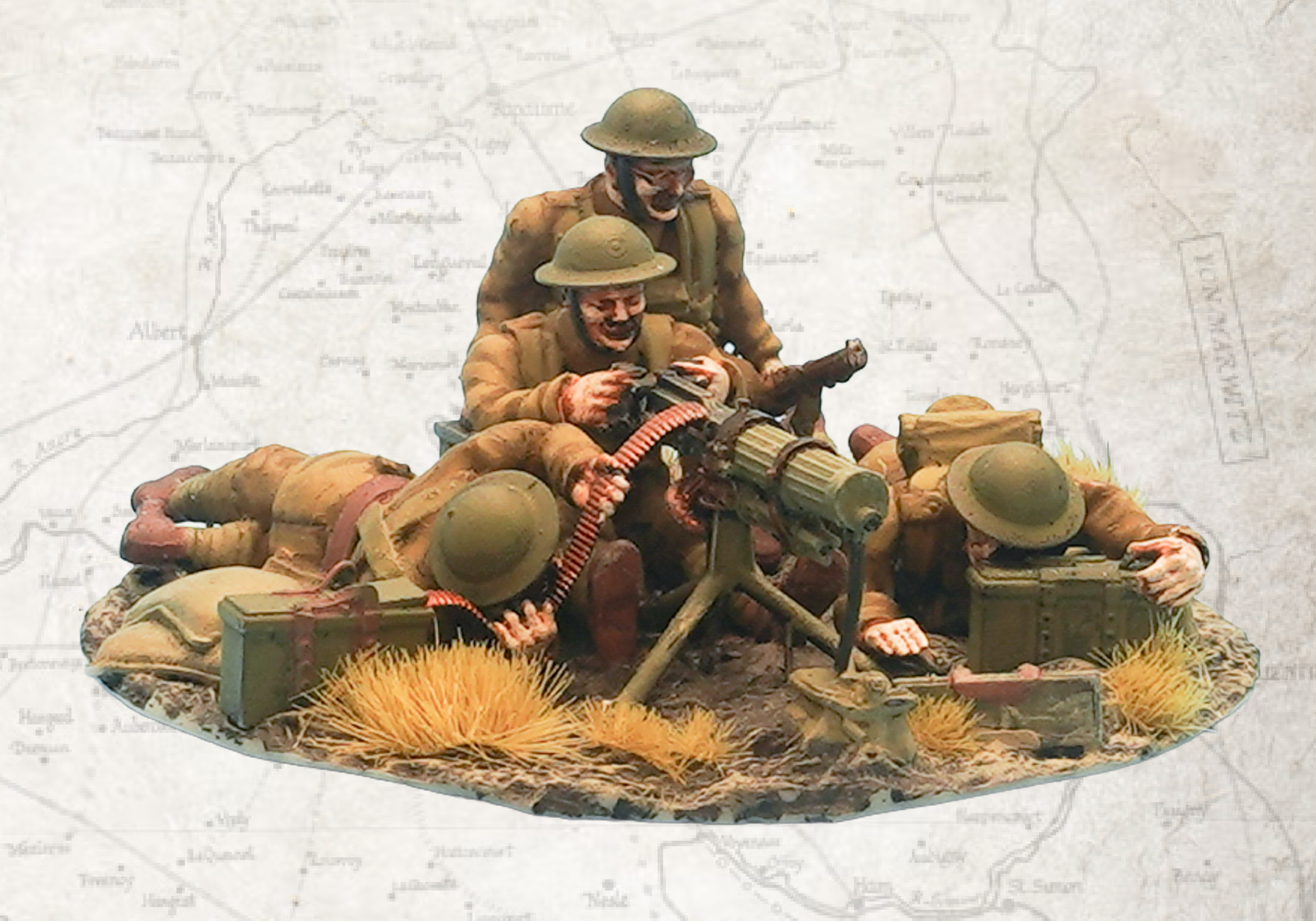
At the Divisional level, an 18pdr field gun can provide strong support - able to pick off enemy armour and respond to troops with canister shot. It can gain the Silent Gun keyword here, staying hidden until you’re ready to reveal it.
It’s in this doctrine that you can make best use of Fortifications too. Pick up a couple of trench sections to keep your Lewis Gunners safe - allowing them to pin down units while staying safe.
Lightning Assault
In this doctrine, you’re able to emulate not just the British, but also the tactics of the Australians and Canadians, who were the shock troops of the British war effort. In particular, the Australian army pioneered ‘peaceful penetration’ - rapid, quiet advances in the dead of night to surprise the enemy up close.
In this doctrine, a mortar section would again serve you well - to pin down units and keep up if needs be. Mobility is key. You can then supplement them with a raiding section - for now you can model a Rifle Section with gas masks to represent this unit, but a dedicated British Raiding Section may be appearing very soon…


To round off the force, a Whippet tank would provide an extremely potent firebase, able to keep pace and support with machine guns.
In the future, this is the perfect list for cavalry sections…**
In next week’s article, we’ll cover how to expand your German Army from the Starter set.
*We are reliably informed that ours is the first ever starter set for wargaming WW1. Neat, huh?
** We've heard that January is the perfect time for horsing about.


Comments